

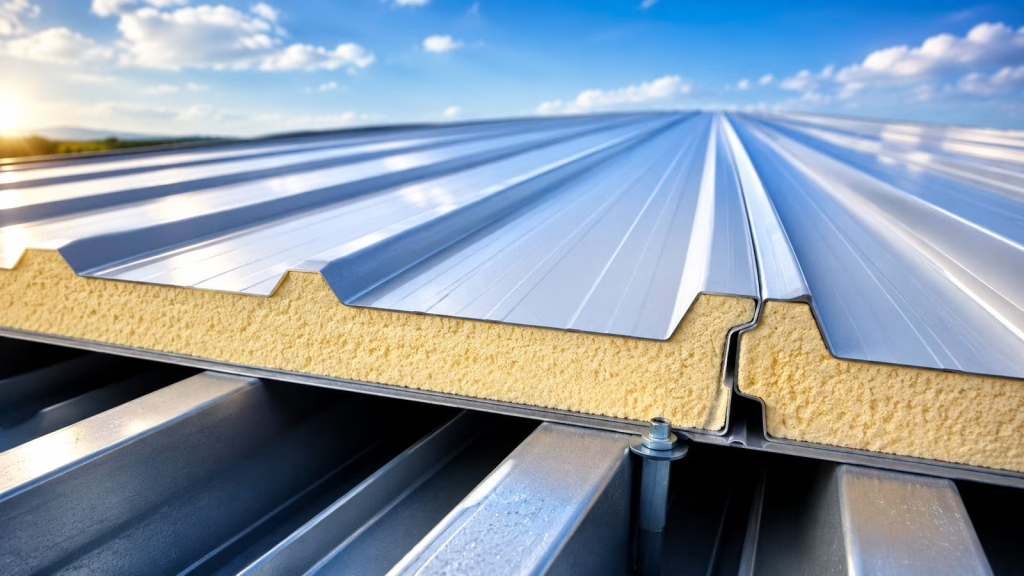
In sandwich panel production, the insulation value, fire behaviour and dimensional stability of the finished product are largely determined by a single decision: whether the right polyurethane raw material system has been selected. However good the panel line, the metal facing quality or the press settings may be, choosing the wrong chemical system for the core foam inevitably results in quality deviation. This article covers the components of polyurethane raw materials, their role in sandwich panel production, the real difference between PIR and PUR, and the technical criteria that should govern raw material selection.
The Components: Polyols and Isocyanates
Polyurethane is not the name of a single substance but a polymer family created by the reaction of two components. In production the system is always defined as two sides.
A-side (polyol blend): This side defines the character of the system. It contains far more than polyol alone: catalysts, surfactants, flame retardants and the blowing agent all sit here. The hydroxyl (OH) value, viscosity and functionality of the polyol determine the crosslink density of the foam and therefore its rigidity and dimensional stability.
B-side (isocyanate): Rigid foam systems predominantly use polymeric MDI. The isocyanate reacts with the polyol to form the urethane bond, while its reaction with water releases carbon dioxide and contributes to blowing.
The mix ratio and reactivity profile of these two components directly affect the operating speed of a panel line. Cream time, gel time and free rise density must all match the line length and belt speed. Detailed information on our Polyols and Polyol MDI systems is available on the relevant product pages.
The Role of PU Foam in Sandwich Panel Production
The core foam in a sandwich panel does not only insulate. It performs three jobs at the same time:
- Thermal insulation: Its closed cell structure and the blowing gas trapped inside the cells deliver a low thermal conductivity value,
- Structural bond: It bonds the two metal facings into a composite section; the bending strength of the panel relies on that bond,
- Dimensional stability: It keeps the panel flat under changing temperature conditions.
All three functions depend on cell structure. A foam with fine, regular cells and a high closed cell content both insulates better and bonds better. Where the cell structure is compromised, panels show delamination or facing waviness within a short service period.
The production method also shapes system selection. On continuous lines reactivity is tuned to belt speed, while on discontinuous presses mould filling time and flow behaviour take priority. These two production routes require different systems; solutions suited to your line are listed on our Sandwich Panel Polyurethane Raw Materials page.
The Difference Between PIR and PUR Systems
The technical question panel manufacturers ask most often is what actually separates PUR from PIR. Both rely on the polyol and isocyanate reaction; the distinction lies in the amount of isocyanate used and the chemical structure that results.
In PUR (polyurethane) systems the isocyanate index is kept at the level required to form urethane bonds. The result is a rigid foam that insulates well and bonds well.
In PIR (polyisocyanurate) systems the isocyanate is used in significant excess. With suitable catalysts, that excess reacts with itself to form a trimer ring structure known as isocyanurate. This ring is thermally far more stable and produces a higher char yield in fire, which slows flame spread.
The practical consequences can be summarised as follows:
- Fire performance: At equal thickness, PIR generally achieves a better reaction-to-fire class,
- Thermal stability: PIR deforms less at elevated temperature,
- Friability: PIR foam can be more brittle, so adhesion and cutting behaviour must be balanced through formulation,
- Processing window: PIR systems are more sensitive to reactivity and temperature control than PUR systems.
PIR is therefore not automatically the right choice in every case. For a cold room panel with no mandatory fire class requirement, a well-formulated PUR system may offer clear advantages in processing ease and adhesion.
Three Core Selection Criteria
1. Fire Class
In Europe the reaction-to-fire class of construction products is determined according to EN 13501-1. The critical point is that the class is awarded to the panel system, not to the foam alone. The same foam can produce a different result with a different facing material or a different thickness. For that reason, the configuration a supplier’s certificate actually covers must always be checked.
2. Density
Core density governs both cost and mechanical strength. Reducing density looks like a saving at first glance, but it can lower compressive strength, weaken adhesion and increase the risk of panel sagging. The difference between free rise density and in-mould density, expressed as the packing factor, must also be accounted for in production planning.
3. Lambda Value
Thermal conductivity sits at the centre of the panel sales argument. The critical distinction here is between the initial value and the aged value. Because the blowing gas in the cells is partly replaced by air over time, the lambda value rises somewhat. Whether a declared figure refers to an aged measurement or a fresh sample should be asked explicitly.
Technical Questions to Ask a Supplier
Sample-based assessment can be misleading; what matters is whether the system behaves consistently in series production. The following points should be clarified during evaluation:
- At what mould and ambient temperature were the cream, gel and free rise values measured?
- Is the declared lambda value aged or measured on a fresh sample?
- Which panel thickness and facing material does the fire class certificate cover?
- What is the shelf life of the components and the recommended storage temperature range?
- How is batch-to-batch consistency documented, and is a certificate of analysis issued per shipment?
- Is technical support provided during line commissioning and formulation adjustment?
Conclusion
Selecting polyurethane raw materials for sandwich panel production is not merely a purchasing line item; it is a direct product quality decision. The reactivity profile of the polyol and isocyanate system must match your line, the choice between PIR and PUR must follow the fire requirement of the project, and density and lambda values must be verified under real production conditions. When these three areas are set up correctly, production waste falls and the field performance of the finished panel becomes predictable.
Contact our technical team to select the polyurethane system best matched to your production line and panel type.