

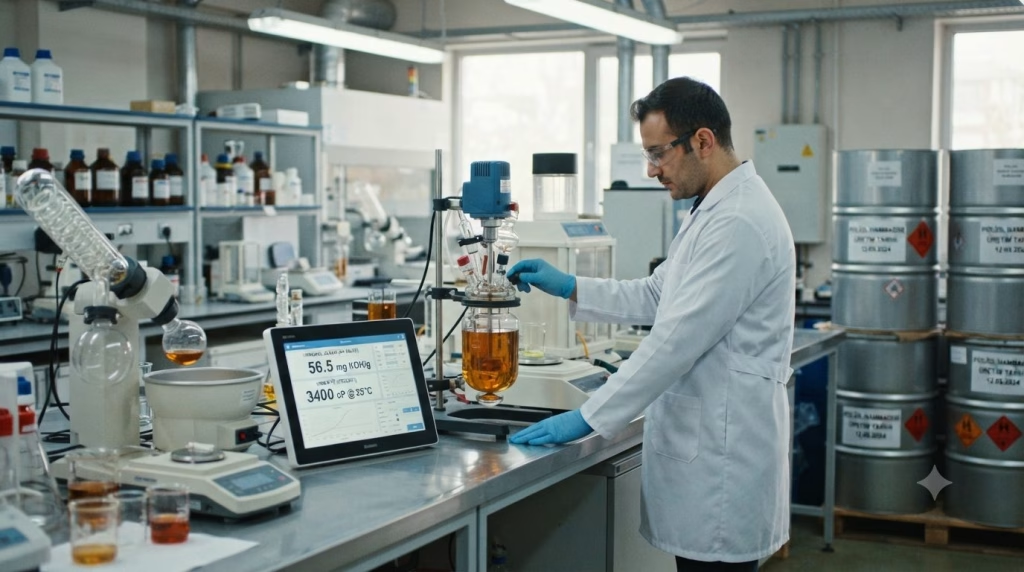
In a plant producing polyurethane, the hardness, density, fire behaviour and ageing performance of the finished product depend largely on a single input. That is why choosing a polyol supplier is not a purchasing line item but a direct product quality decision. A poorly selected polyol may look faultless in the first weeks of operation and then return, once the season changes, as reactivity drift, density deviation or adhesion loss. This article covers the role of polyol in a polyurethane system, the difference between polyester and polyether grades, the seven technical criteria to apply when evaluating a polyol supplier, and how to qualify a new source.
What a Polyol Is and What It Does in a Polyurethane System
A polyol is a compound carrying more than one hydroxyl (-OH) group in its molecule. Polyurethane forms when polyol reacts with isocyanate: the hydroxyl group joins the isocyanate group and creates the urethane bond. Polyurethane is therefore not a single substance but a polymer family born from the controlled reaction of two components.
What the shop floor calls the “A-side” or simply “the polyol” is in fact a formulated blend. It contains far more than polyol alone:
- Polyol: The backbone of the system; its chain structure sets the flexibility and rigidity of the final product,
- Catalysts: Setting the speed of the gelling and blowing reactions and the balance between them,
- Surfactant: Silicone based additives that regulate cell structure and reduce cell size,
- Blowing agent: Expanding the foam and, by remaining trapped in the cells, contributing directly to the insulation value,
- Flame retardant: Added where a reaction-to-fire requirement applies.
For this reason, “polyol price” alone is not a meaningful basis for comparison when talking to a polyol supplier. Two systems sold under the same name can behave completely differently on the line because their catalyst balance and additive package differ. The full range is available on our Polyols page.
The Difference Between Polyester and Polyether Polyols
Polyols used in polyurethane formulation fall into two main families, and that distinction directly governs application choice.
Polyether polyols are built on ether linkages. They resist hydrolysis, have low viscosity and are easy to process. They form the basis of flexible foam, spray foam and many rigid foam applications, and are preferred wherever long service life in damp conditions is expected.
Polyester polyols carry ester linkages. They offer higher mechanical strength, better oil and solvent resistance and stronger fire performance. They stand out in sandwich panel, shoe sole and coating systems. In return their viscosity is higher and their hydrolytic stability is lower than polyether grades, which must be accounted for in permanently damp environments. Detailed product information is available on our Polyester Polyols page.
In practice many systems use both families together: polyester for mechanical strength, polyether for processability and hydrolytic stability. Supplier evaluation should therefore begin not with “which polyol” but with “which application, under which conditions”.
Seven Technical Criteria for Selecting a Polyol Supplier
When evaluating a polyol supplier, the quoted price is only one input. The seven headings below form the technical framework that determines how the system behaves in the field.
1. Hydroxyl (OH) Value and Its Tolerance
The OH value expresses how much hydroxyl group the polyol carries per gram, stated in mg KOH/g. Because it determines the number of active sites available to react with isocyanate, it directly affects the mix ratio.
What matters is not only the declared figure but its tolerance. A system held within ±2 mg KOH/g behaves very differently from one fluctuating within ±8, producing different hardness and density from the same formulation. Asking the supplier for the tolerance band up front prevents most of the recipe corrections that would otherwise follow.
2. Viscosity and Temperature Dependence
Viscosity determines how much material the dosing pump delivers at a given speed. The common mistake here is treating viscosity as a single number, when in fact it changes markedly with temperature.
As a component cools in winter its viscosity rises, the pump delivers less, and the actual mix ratio drifts from target. Viscosity should therefore always be requested together with its measurement temperature, and storage and feed line temperatures should be recorded. Those records are the fastest route to diagnosing ratio deviations.
3. Functionality and Molecular Weight
Functionality is the average number of hydroxyl groups per molecule and governs crosslink density. Higher functionality means more frequent crosslinks, therefore a harder and dimensionally more stable structure, which is exactly what rigid foam and panel applications require. Lower functionality produces a more flexible, more extensible structure.
Molecular weight must be assessed alongside functionality. Two polyols with the same OH value can deliver entirely different mechanical results if their molecular weights differ.
4. Water Content and Acid Value
Water in the polyol reacts with isocyanate and releases carbon dioxide. That is additional blowing not accounted for in the formulation: density drops, cell structure degrades and voids can appear in the panel. In rigid systems water content is typically held to a few parts per thousand by weight and should be measured on every shipment.
Acid value matters particularly for polyester polyols. A high acid value suppresses catalyst activity and slows reactivity, so the line behaves differently even though the recipe has not changed.
5. Batch-to-Batch Consistency
Assessment based on a single sample can mislead. Suppliers generally send their best batch as a sample; what actually matters is whether the system behaves consistently in series production.
The only objective indicator is a certificate of analysis per shipment. Catalogue values show the target; the certificate of analysis shows what actually arrived. Archiving these documents is the only way to determine, months later, which variable was responsible for a quality dispute.
6. Documentation and Regulatory Compliance
Because polyurethane raw materials are used together with isocyanates, they fall squarely within the scope of occupational health and safety regulation. Suppliers should provide a safety data sheet in current format, a technical data sheet and, where required, a reaction-to-fire certificate.
For the good practice guidance followed by producers and suppliers in the European market, the resources of ISOPA (the European Diisocyanate and Polyol Producers Association) are a useful reference. A supplier’s participation in such industry programmes is a strong indicator of how seriously its documentation is managed.
7. Technical Support and Continuity of Supply
The value of a polyol supplier becomes visible when something goes wrong. Will they adapt the formulation during line commissioning? Is there field support when reactivity drifts at a seasonal transition? Can an alternative system be proposed during a stock interruption?
Continuity of supply is also a risk item. A formulation tied to a single source halts production the moment that source is interrupted. For critical systems, having a second approved source already qualified is worth more than a price advantage.
How to Qualify a New Polyol Supplier
Changing supplier is not a commercial decision but a technical transition. A rushed changeover can generate waste far exceeding the saving. A sound qualification usually follows this sequence:
- Technical matching: The OH value, viscosity, functionality and reactivity profile of the current system are given as targets,
- Laboratory verification: Free rise density, cream and gel times are measured on the sample,
- Limited production trial: A single shift or single batch is run on the line; production is not converted wholesale,
- Sample retention: Sections taken from the trial are labelled and stored as a future comparison reference,
- Phased transition: If results are accepted, production is moved to the new system in stages.
The step most often skipped here is sample retention. Without a comparison reference, a complaint arriving months later cannot be traced to either the raw material or a process change.
Storage, Shelf Life and Safety
Once the right polyol supplier is chosen, how the material is managed in the plant also determines performance. Storage temperature is generally held between 15°C and 25°C. At low temperatures some polyol blends can separate or crystallise; at high temperatures catalyst activity changes over time and reactivity drifts.
Stock rotation should follow first in, first out, with every drum labelled with its receipt date and batch number. A component past its stated shelf life is not automatically waste, but a reactivity check must be carried out and recorded before use.
Moisture is a separate risk on the isocyanate side: it reacts with atmospheric humidity to generate carbon dioxide inside the container, causing both pressure build-up and skin formation. Partly used drums should be blanketed with dry nitrogen. The complete range is listed on our Raw Materials and Auxiliary Chemicals page.
Common Mistakes
- Comparing price alone: Two systems with different catalyst packages can be sold under the same name,
- Not asking about tolerance: How much the declared OH value fluctuates matters as much as the value itself,
- Treating viscosity as temperature independent: Most winter ratio deviations originate here,
- Not requesting a certificate of analysis: The catalogue shows the target, the certificate shows reality,
- Buying polyol and isocyanate from different suppliers and expecting identical performance: The catalyst balance is designed around a specific isocyanate reactivity,
- Relying on a single source: Qualifying an alternative takes weeks once an interruption has already started.
Conclusion
Selecting the right polyol supplier is a far broader decision than comparing price lists. When OH value and its tolerance, temperature-dependent viscosity behaviour, functionality, water and acid values, batch-to-batch consistency, documentation discipline and technical support capacity are assessed together, production consistency improves and field problems become predictable. In supplier evaluation the most reliable indicator is not the performance of a single sample but the consistency demonstrated across repeated shipments.
Our Polyurethane Prepolymers and Sandwich Panel Polyurethane Raw Materials pages complete the picture for prepolymer based systems and panel production. For the sourcing process in full, see our article on PU Foam Raw Material: Sourcing Process and Supplier Selection Criteria.
Contact us to identify the polyol system suited to your production type and to request technical documentation and samples.