

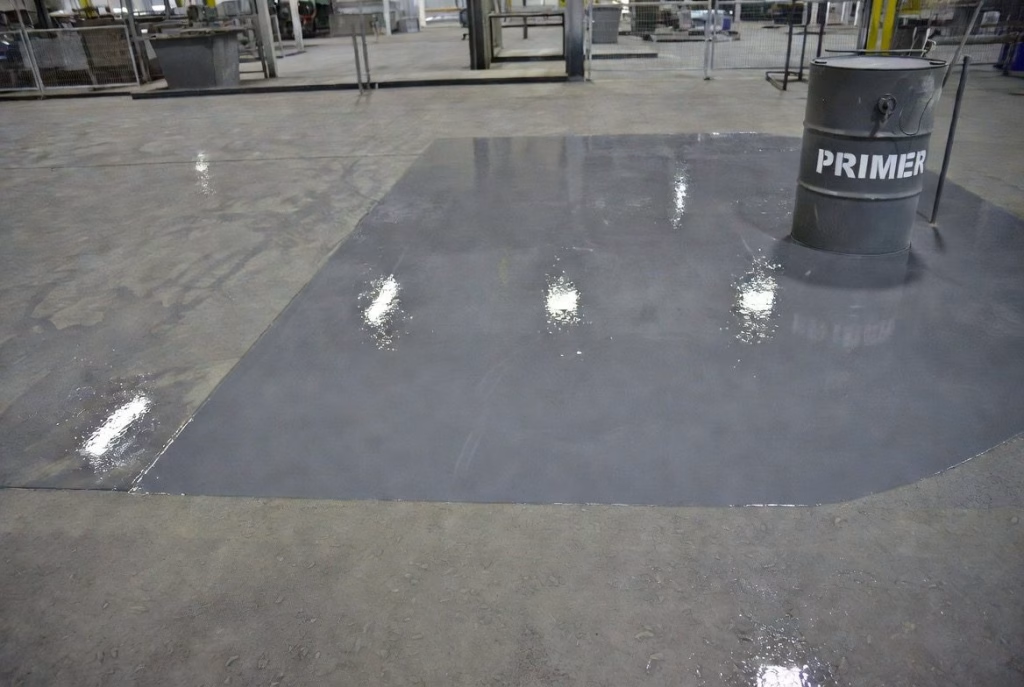
In floor coating systems the most debated layer is the one nobody sees. Once the work is finished it is invisible, it represents a small share of the cost, and for exactly that reason it is the first item to be cut. Yet the majority of delamination and blistering problems encountered on site trace back directly to a decision about the epoxy primer. This article covers the role of the primer in the system, how it improves adhesion, the differences between primer types, the correct application process, and the mistakes made most often on site.
What an Epoxy Primer Is and What It Does
An epoxy primer is a low-viscosity blend of epoxy resin and hardener, formulated to penetrate concrete. Its purpose is not to form a coating but to establish a transition zone between two very different materials.
Concrete is porous, absorbent and variable in surface energy. Epoxy mortars and self-levelling systems, by contrast, are viscous and high in solids. Bringing the two together directly makes the bond dependent on the weakest few millimetres at the concrete surface. The primer penetrates that zone, consolidates it, and moves the bond deeper.
A primer performs four core functions in the system:
- Penetration and consolidation: It saturates the weak surface layer and strengthens it mechanically,
- Absorbency equalisation: It keeps the layer above at consistent thickness across areas of differing porosity,
- Air release control: It prevents air from capillaries in the concrete from creating pinholes in the layer above,
- Moisture management: Selected in the appropriate type, it limits how much moisture from the substrate reaches the coating.
How a Primer Improves Adhesion
Adhesion relies not on one mechanism but on three acting together: mechanical keying, chemical bonding and surface wetting.
Mechanical keying requires an open, porous surface. The texture opened by grinding or shot blasting allows the primer to flow in and cure, forming micro-anchors.
Surface wetting is a question of viscosity. A low-viscosity primer enters capillaries that a thick coating could never reach. The aim, therefore, is not to apply the primer thickly but to work it in well.
Chemical bonding occurs between the primer and the layer above. Once the primer has fully cured its surface becomes chemically passive, which is why the topcoat must be applied within the overcoating window stated by the manufacturer. If that window is missed, the surface must be lightly abraded or given a mechanical key by broadcasting sand.
How It Prevents Moisture-Related Problems
Moisture within concrete evaporates beneath the coating and generates pressure. When that pressure exceeds the adhesion strength of the coating, blisters appear and debonding follows. The problem usually surfaces weeks after application, which is why its cause is so often misdiagnosed.
Moisture-tolerant and moisture-barrier primers are formulated to limit this vapour transmission. It is worth being realistic here, however: no primer permanently resolves a floor with a continuous water supply beneath it. Where rising damp is present, the real solution is to cut off the water source; the primer only manages the residual moisture load. Where that distinction is not made, the system fails again within a few years.
Solvent-Based, Water-Based and Solvent-Free Primers
Solvent-Based Primers
Solvent lowers resin viscosity and delivers excellent penetration, which is an advantage on dense, closed concrete. In return these products contain volatile organic compounds and require ventilation and safety precautions in enclosed areas. Many facilities avoid them for this reason.
Water-Based Primers
Water-thinned systems can be applied to damp concrete and have low emissions. Because their drying depends on water evaporation, they are sensitive to ambient humidity and ventilation. They are frequently specified in healthcare buildings and food facilities where work proceeds while the site remains in use.
Solvent-Free Primers
These are high-solids, fully reactive systems. They fill pores effectively and leave more material in a single coat. This is the type most commonly used beneath industrial mortar systems. Combined with broadcast quartz sand, it creates an ideal mechanical key for the layer above. 2K Epoxy Primer in this category provides a consistent base across concrete surfaces of varying absorbency.
The Application Process
- Surface preparation: Laitance is removed mechanically and the surface is vacuumed free of dust,
- Ambient control: Substrate temperature must be at least 3°C above dew point, and moisture readings should be recorded,
- Mixing ratio: Components A and B are combined at the stated ratio by weight and in full; splitting units by eye is not acceptable,
- Mixing: A low-speed mixer is used without entraining air, scraping the sides and base of the container,
- Application: Distributed evenly by roller or squeegee, leaving no ponding,
- Sand broadcast: Where required, quartz sand is broadcast into the wet primer to create a key for the next layer,
- Overcoating window: The next layer is applied between the stated minimum and maximum waiting times.
Pot life starts counting from the moment of mixing. In hot weather that period shortens noticeably, so it is better to mix only what can be applied rather than preparing large batches.
Common Mistakes
- Skipping the primer: The most expensive mistake of all, since it typically ends in replacing the entire system,
- Leaving ponded material: Thick accumulations do not cure fully and form a soft intermediate layer,
- Incomplete mixing: Unmixed hardener left at the base of the container produces tacky, uncured patches,
- Missing the overcoating window: Applying directly onto a fully cured primer leads to interlayer separation,
- Starting without moisture testing: The result is usually blisters appearing weeks later,
- Assuming one coat is enough: On highly absorbent concrete the first coat is fully absorbed and a second may be required.
Conclusion
The epoxy primer is the cheapest yet most decisive layer in the system. The correct type should be chosen together with an assessment of concrete absorbency and moisture condition, and mixing ratio, pot life and overcoating window must be followed with discipline during application. A few hours of care spent on this layer extends the life of the floor system by years. For the complete system, see our Epoxy Floor Coating Systems page.
Contact our technical team to select the primer suited to the absorbency and moisture condition of your floor.