

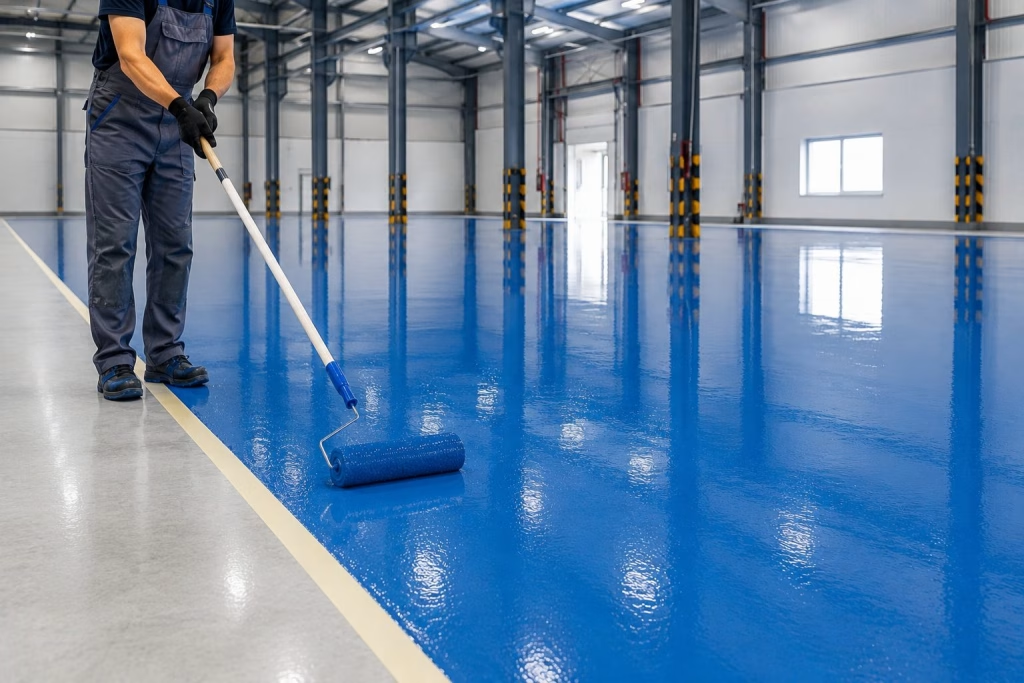
In an industrial facility the floor is far more than a surface to walk on: it directly affects hygiene, workplace safety, cleaning cost and production continuity. Epoxy floor coating systems deliver measurable gains in these areas by eliminating the weaknesses of bare concrete, namely dusting, chemical absorption and abrasion. This article covers the technical properties of epoxy floor coatings, the environments they suit, the layers that make up a system, concrete surface preparation, and how epoxy compares with polyurethane.
Properties of Epoxy Floor Coatings
When epoxy resin is mixed with a hardener it reacts chemically to form a highly crosslinked, hard and dense film. That structure brings together several properties sought in industrial flooring:
- High compressive strength: Resists forklift traffic and point loading,
- Abrasion resistance: Low surface loss under continuous wheeled and foot traffic,
- Chemical resistance: Protects concrete against oils, fuels and many acids and alkalis,
- Non-porous surface: Absorbs no liquid, supports hygienic cleaning and stops dust generation,
- Strong adhesion: Bonds firmly to correctly prepared concrete.
The limitations of epoxy stem from the same hardness. High crosslink density makes it rigid, which in turn limits flexibility, and it tends to yellow under direct sunlight. These two points are the main constraints that drive system selection.
Which Facilities Suit Epoxy Flooring?
Factories and Production Areas
Around machine plinths, assembly lines and forklift routes, mechanical strength is the priority. Thicker, aggregate-filled systems are usually specified here. Marking walkways and hazard zones through colour separation adds a direct workplace safety benefit.
Warehouses and Logistics Centres
In large-span warehouses the critical issues are surface flatness and cleanability. A dust-free floor reduces contamination of racking systems and packaged goods, and improves the efficiency of floor scrubbing machines.
Food and Beverage Facilities
A non-porous surface is a hygiene requirement in these plants. Carrying the coating continuously into a coved skirting at the wall junction prevents wash water from penetrating the joint. Where hot water washdown is used, thermal shock resistance becomes decisive and polyurethane based systems are generally more suitable.
Healthcare Buildings
In hospitals and laboratories the priorities are disinfectant resistance, low emissions and ease of cleaning. Because static load requirements are lower, thinner systems are usually sufficient.
The Layers of an Epoxy System
An epoxy floor is not a single product but a layered system. Omitting one layer weakens the whole.
Primer
The primer evens out the absorbency of the concrete, fills fine surface pores and creates a key for the layers above. Applying without a primer is the most common and most expensive mistake in the trade, and it typically results in early delamination. Products such as 2K Epoxy Primer provide a consistent base across concrete surfaces of varying absorbency.
Body Coat
This layer determines the thickness and mechanical strength of the system. Quartz-filled mortar systems are preferred under heavy loading, while self-levelling systems produce a smooth and decorative finish.
Top Coat
The topcoat governs chemical resistance and surface appearance. Where slip resistance is required, aggregate is broadcast into this layer; where UV exposure is expected, an aliphatic polyurethane topcoat is specified instead of epoxy. 2K Aliphatic PU Top Coat is used for this purpose.
Concrete Surface Preparation
The large majority of epoxy floor failures originate not in the material but in surface preparation. The correct sequence is as follows:
- Concrete maturity: Freshly poured concrete should generally be left at least 28 days,
- Moisture testing: Concrete moisture content must be measured, and a moisture-tolerant primer planned where readings are high,
- Mechanical preparation: Laitance and old coating residues are removed by grinding or shot blasting; acid etching is not recommended for industrial work,
- Repair: Cracks, joint arrises and surface defects are made good with an epoxy based repair mortar,
- Cleaning: Dust is removed with an industrial vacuum; sweeping alone is not sufficient,
- Ambient control: Substrate temperature must be at least 3°C above the dew point.
A pull-off adhesion test is the most objective way to confirm that preparation has been adequate. The generally accepted threshold is 1.5 N/mm².
Epoxy or Polyurethane?
The two systems are often treated as alternatives, yet they solve different problems.
Epoxy is harder, offers higher compressive strength and is generally more economical. It performs strongly indoors, under heavy mechanical loading and where chemical protection is required.
Polyurethane is more flexible and more resistant to thermal shock and UV exposure. It comes into its own in food plants with hot water washdown, in outdoor car parks and wherever temperature fluctuation is significant.
In practice the most common solution combines both: mechanical strength comes from the epoxy primer and body coat, while UV and chemical protection come from an aliphatic polyurethane topcoat. System options are listed on our Epoxy Floor Coating Systems page.
Joints and Detailing
Problems in floor coatings rarely start in open areas; they start at details. These points must be designed as an integral part of the system.
Movement joints should never simply be coated over. If a joint in the concrete is buried beneath the coating, movement will tear the coating and produce an irregular crack. The joint must be carried through the coating and sealed with a flexible joint filler.
Wall junctions are resolved with a coved skirting in facilities requiring hygiene, which prevents soil accumulation in the corner and stops wash water penetrating the junction.
Drain surrounds are where the coating is most severely tested. The coating should be terminated inside the drain rather than finishing at the surface; otherwise water ingress at the edge is inevitable.
Machine plinths are subject to vibration and thermal movement together. Carrying the coating up onto the plinth with a flexible transition detail prevents edge cracking.
Conclusion
Applied in the right type of facility with the right layer build-up, an epoxy floor coating is an investment that extends the life of the concrete, lowers cleaning cost and contributes to workplace safety. Three factors determine system performance: the quality of surface preparation, the suitability of the layer build-up to the service loading, and control of ambient conditions. When all three are satisfied, epoxy floors serve for many years with minimal maintenance.
Contact our technical team to determine the floor system best matched to the loading conditions and hygiene requirements of your facility.